
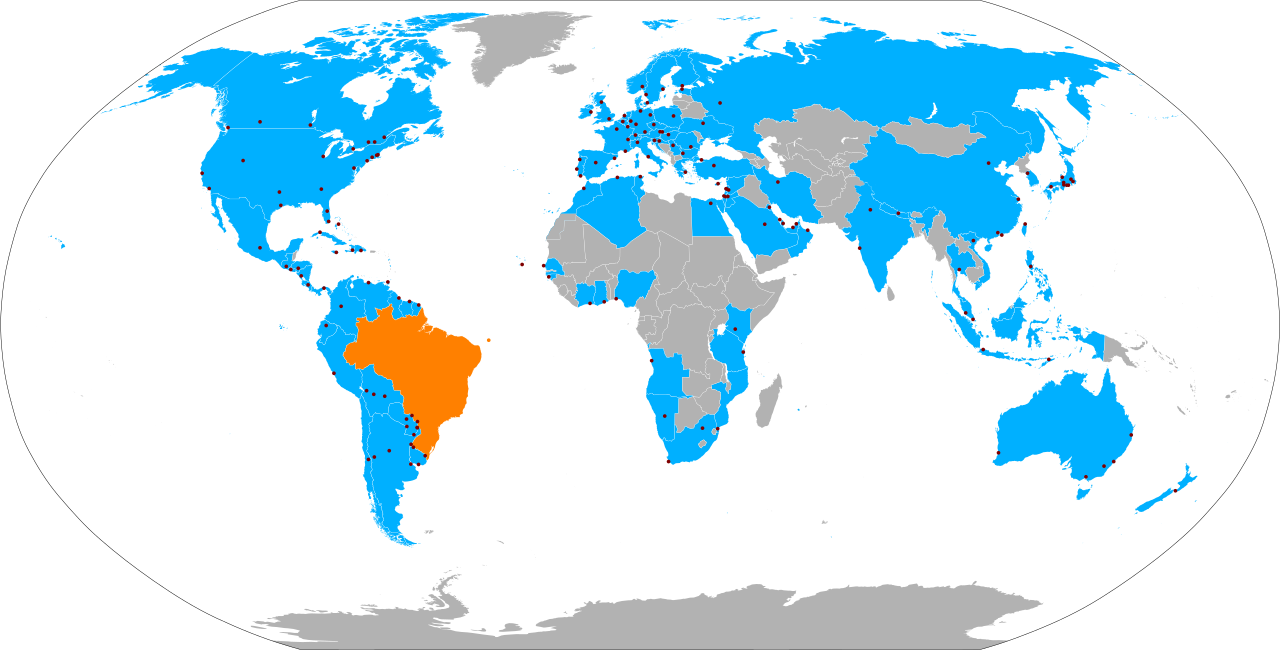

Almost one million Brazilians abroad, living in over 134 countries, are eligible to vote in Sunday’s tight presidential run-off race, amounting to roughly 0.5% of the vote.
Speaking to Brazil Reports, Brazilians abroad cited concerns ranging from corruption to safety that have determined their choice between incumbent President Luiz Inácio da Silva of the Worker’s Party (PT), Flávio Bolsonaro of the Liberal Party (PL).
Many others are abstaining altogether, apathetic to the polarized politics of their home country.
The first round of the general election took place on Sunday, October 4, when Brazilians took to the polls to cast their vote for one of 13 candidates.
Whilst the results at the end of the first round overall were 45.16% for Lula and 47.0% for Bolsonaro, the abroad vote resulted in 47.57% of the vote for the incumbent and 43.49% for his challenger.
“I voted for Lula in the first round. And I will vote for him again,” said 34-year-old Felipe Dantas, who moved from Rio de Janeiro to Barcelona five years ago. Apart from his sister, who also lives in Spain, the rest of Dantas’ family still live in Rio.
He believes that, following the first round defeat, Lula’s campaign is “back on track”.
“I do feel hopeful for the second round. I think that Lula can overturn the loss of the first one,” Dantas told Brazil Reports.
Though no candidate since Brazil’s return to democracy in 1989 has overturned a first-round electoral loss, Dantas believes the recent wave of mobilizations in Brazil could help defy these odds.
“We are seeing huge mobilizations on the streets, on social media. People are now starting to gather, trying to change votes from their co-workers and neighbours. They are huge mobilizations,” said Dantas.
Protests related to the upcoming elections have been taking place across Brazil.
Lívia de Moraes, who lives in Niterói, near Rio de Janeiro, said that the protests started at her university, the Universidade Federal Fluminense (UFF).
“The first march [for Lula] was held by the law school at my university… It took place in Niterói at night, right after a class ended. The video of the students went viral, and the student movement started growing all over the country,” she told Brazil Reports.
The demonstrations have also spread beyond Brazil.
On Sunday, October 18, YourParty, a British Socialist Party founded by ex-Labour members Jeremy Corbyn and Zarah Sultana, held a ‘March for Brazil’. Footage from the march shows Corbyn giving a speech in support of Lula from London’s Parliament Square.
Major pro-Lula demonstrations have also taken place in Paris, Lisbon, Berlin and Sydney, and protesters have often held signs mobilizing ‘against facism’.
Voters like Dantas helped Lula win the vote in Spain, along with other European countries like France, Germany, and Portugal – his largest overseas win.
But his opponent outperformed him in the United States, home to some 2 million Brazilians.
In the first round, Bolsonaro received 45,004 votes in the U.S. compared with Lula’s 23,355.
Amongst his supporters is Ivana Silva, a naturalized U.S. citizen who moved from São Paulo to the United States 27 years ago.
Silva will be casting her ballot in Miami on Sunday, which she said will mark her first time voting in a Brazilian election since leaving her home country.
She believes that Flavio Bolsonaro, the son of ex-president Jair Bolsonaro, is the correct choice for Brazil’s next president. Silva described the 2018 assassination attempt against Jair Bolsonaro as her “political awakening”, which led her to “become increasingly concerned about Brazil’s future”.
“I believe Brazil deserves better than the corruption, political ideology, and disregard for traditional family and Christian values that I associate with the Worker’s Party,” Silva told Brazil Reports.
She also addressed the 2023 coup attempt by Jair Bolsonaro, who tried to overturn his defeat to Lula and was consequently imprisoned for an assassination attempt.
Silva, like many Bolsonaro supporters, believes the ex-president was unjustly charged: “I am also deeply concerned about what I see as political bias within Brazil’s Supreme Court and the treatment of Bolsonaro and those arrested in connection with the January 8 events.”
“To me, this election is about much more than left versus right. It is about freedom, justice, faith, democracy, and the future of a country I love,” continued Silva.
Flagging turnout
While many voters feel strongly about the election, the overwhelming trend is one of apathy; whilst almost 916,500 Brazilians abroad were eligible to vote, only 341,766 did so, amounting to a turnout of just 37.31%.
This growing disengagement with politics is a problem in Brazil, too, where only 78.9% of eligible voters turned out in the first round. This makes it the highest first round abstention rate since the 1998 elections.
“There is frustration among the progressive base with the Lula administration and little mobilization around Flávio Bolsonaro,” said Murilo Medeiros, a political scientist at the University of Brasília (UnB), in an interview with Valor International.
As Medeiros references, there is a lot of controversy surrounding these elections. Bolsonaro’s campaign is widely associated with far-right populism, and he has proposed to mend Brazil’s relationship with Israel, improve tax conditions for professionals, and bring in spending cuts.
The right-wing candidate has also allied himself with President Trump of the United States, spurring allegations of democratic meddling by the White House.
Lula, meanwhile, has been president for three non-consecutive terms. In 2017, he was convicted of money laundering and corruption, landing him a 580-day sentence in prison, which was later nullified in 2021 by the Supreme Federal Court, which found bias in the case.
Brazilians around the world will be keenly watching Sunday’s results, which will determine the direction of their country for the next 4 years. Official counting begins at 5PM Brasília time (8PM GMT).
Featured image description: Map of voting locations of the 2026 Brazilian elections across the world.
Featured image credit: Heitordp via Wikimedia Commons