On October 19, Brazil’s Superior Electoral Court gave U.S. tech giant Meta 24 hours to prove it is treating the Brazilian presidential candidates equally, following allegations from President Luiz Inácio Lula da Silva’s campaign that the company was favoring his opponent, Flávio Bolsonaro.
The ultimatum was the latest allegation from the highest levels of Brazilian government of U.S. interference in the knife-edge election.
With the two candidates now heading into a runoff on Sunday, October 25, concerns over potential U.S. involvement have raised questions about whether external pressure could affect the outcome of an election with significant regional and international consequences.
This controversy comes amid a tight race, with Flávio Bolsonaro taking 47% of votes compared with Lula’s 45% in the first round earlier this month.
It also follows a warning last month by the Brazilian Intelligence Agency (ABIN) of escalating U.S. pressure on Brazil’s presidency, Justice Ministry and Superior Electoral Court. The intelligence assessment reportedly elevated the risk of U.S. influence over Brazil’s elections to a critical level.
Allegations of interference
Since returning to office last year, the Donald Trump administration has had contentious relations with Brazilian institutions. In 2025, it imposed sanctions on Supreme Court Justice Alexandre de Moraes over his role in convicting Brazil’s former president Jair Bolsonaro, who had close ties to Trump and is currently in prison for attempting to orchestrate a coup to overturn his loss to Lula in the 2022 Brazilian elections.
The White House also raised tariffs on Brazilian imports in response to Bolsonaro’s imprisonment.
Flávio Bolsonaro, the son of Jair, has explicitly proposed closer relations with the U.S. and stronger opposition to the governments of Cuba and Venezuela, aligning with the White House’s interests. Meanwhile, a Lula victory would see a closer alignment with China under the BRICS organization.
The allegations against Meta center on several reported irregularities, including a nearly 24-hour period when Lula’s campaign was unable to promote Instagram posts, while Bolsonaro’s campaign faced no equivalent restriction.
Complaints have also emerged over the removal or reduced visibility of pro-Lula content and inconsistencies in Meta’s AI tools, which reportedly generated campaign images supporting Bolsonaro while rejecting similar requests for Lula.
While Meta has denied political bias, attributing the incidents to technical failures and errors in its automated systems, the controversy has intensified scrutiny of how a U.S.-owned technology company’s control over political advertising and content distribution could affect Brazil’s electoral process.
Kate Millar, former Foreign Information Manipulation and Interference (FIMI) consultant and “grey zone warfare” specialist, spoke to Latin America Reports about the alleged interference.
The European External Action Service defines FIMI as “a mostly non-illegal pattern of behaviour that threatens or has the potential to negatively impact values, procedures, and political processes.”
Millar explained that FIMI’s definition is technically “actor-neutral” but in practice the term is often used by Western democracies investigating Russia or China, adding that she herself has researched Russian FIMI in the Moldovan elections.
Millar added that FIMI differs from disinformation in that it does not necessarily involve spreading false information, but can include the strategic dissemination and “artificial amplification” of content.
She described it as a “pattern of behaviour that is intentional, coordinated and manipulative, and which is designed to distort the information environment in ways that can negatively affect political processes, institutions and democratic values.”
This distinction is relevant to the allegations against Meta, where concerns centre on whether unequal restrictions and algorithmic amplification have distorted the visibility of competing political messages.
FIMI operations often involve disseminating information that is accurate but released strategically and “artificially amplified”; it is a “pattern of behaviour that is intentional, coordinated and manipulative, and which is designed to distort the information environment in ways that can negatively affect political processes, institutions and democratic values”.
Millar also noted that the Brazilian Intelligence Agency shared its concerns over U.S. interference with French and German officials who visited Brazil in September to discuss online regulation, disinformation and election security; the ABIN officials reportedly told their European guests that interference by both the United States and Russia was occurring.
She said that it is thus relatively unusual to see the US questioned over FIMI practices as the U.S is officially a “democratic ally” of Brazil.
The White House has also drawn scrutiny over an unusual donation timed just days before the first round election: it earmarked US$1 million to “Countering lawfare and censorship in Brazil,” allocating the funds to Brazilian civil society groups.
Millar told Latin America Reports that FIMI operations often involve concealment of foreign funding and foreign entities sponsoring or posing as civil society groups or domestic actors, pointing to the $1 million donation.
Though Brazil’s Federal Police closed its initial criminal investigation into the donation in under a week, Millar said this decision “should not be ignored”.
“It doesn’t dispose of the FIMI question,” said the expert, adding, “a criminal investigation asks whether there is evidence of an offence; a FIMI assessment asks whether intentional, coordinated and manipulative foreign behaviour is distorting an information environment.”
Millar noted that FIMI is hard to identify because its “mostly non-illegal activities” mean it can undermine democracies without meeting the threshold for a criminal investigation to take place.
She said both tariffs and sanctions can also be considered “coercive statecraft” to influence another country’s behaviour without necessarily resorting to military force.
If U.S. interference can be formally proven, said Millar, the Brazilian elections would represent a “landmark” case of a “democratic ally” being called to account for foreign interference.
Brazil is Latin America’s largest democracy and accounts for approximately 31% of Latin America and the Caribbean’s GDP. As an agricultural superpower and founding member of BRICS, its political leadership holds considerable influence regionally and globally.
The outcome of the presidential runoff between Lula, whose policies include protecting workers’ rights and reducing illegal deforestation, and Flávio Bolsonaro, who would introduce tougher criminal justice policies and pardon his father Jair Bolsonaro, could therefore reshape the Latin American political landscape for many years to come.
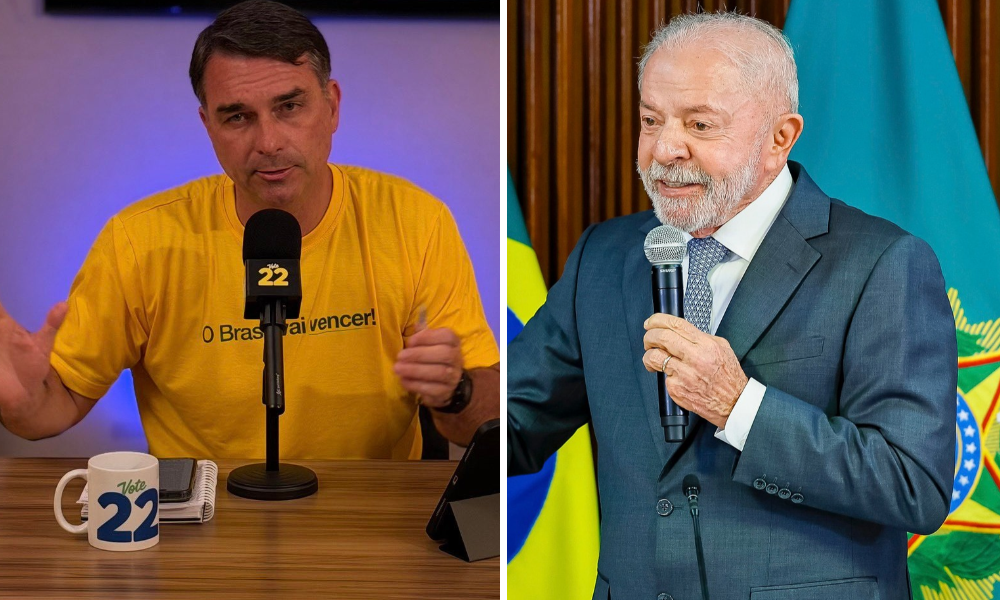
Featured image description: Flavio Bolsonoro (L) and Luiz Inácio Lula da Silva (R).
Featured image credit: @FlavioBolsonaro and @LulaOficial via X.