

Much has been written about what Luiz Inácio Lula da Silva’s astounding October 25 victory over Flávio Bolsonaro means for Brazil’s security, democracy, and economy, and for its fraught relationship with the Donald Trump administration. Significantly less has been written about what it means for Brazil’s position in the world, and the world’s position in Brazil.
As Latin America’s largest economy and a founding member of the BRICS organization, Brazil increasingly acts as both a regional and a global power, and Lula plainly sees it that way. His diplomacy rests on consistent priorities: defending democracy, negotiating an end to conflicts, promoting multipolarity and multilateralism, reforming the UN and international financial institutions, and deepening South-South cooperation, an approach the Atlantic Council describes as preserving Brazil’s autonomy through diversified partnerships.
His most volatile relationship remains the one with Washington. Lula worked closely with the Bush, Obama, and Biden administrations, but ties have deteriorated sharply under Trump, whose administration sanctioned Justice Alexandre de Moraes over Jair Bolsonaro’s coup conviction and raised tariffs over his imprisonment. Key Trump allies, including Jason Miller and Steve Bannon, were allegedly involved in the coup plot.
This July, after meeting Bolsonaro, Trump announced a new 25% tariff that more than half of voters, according to a Datafolha poll, believed was meant to sway the election. Lula’s campaign also accused Meta of suppressing its content, and the ex-partner of far-right digital operative Fernando Cerimedo alleged he had met a Bolsonaro family member in the U.S. to discuss the campaign. After the vote, Trump said he liked Lula but that the election appeared “rigged,” despite no evidence.
What’s at stake in the Brazil-U.S. relationship?
Though fraught, the relationship between the two remains highly lucrative. Bilateral goods trade reached US$94 billion in 2025, the United States is Brazil’s largest foreign investor, and 1.9 million Brazilians visited last year.
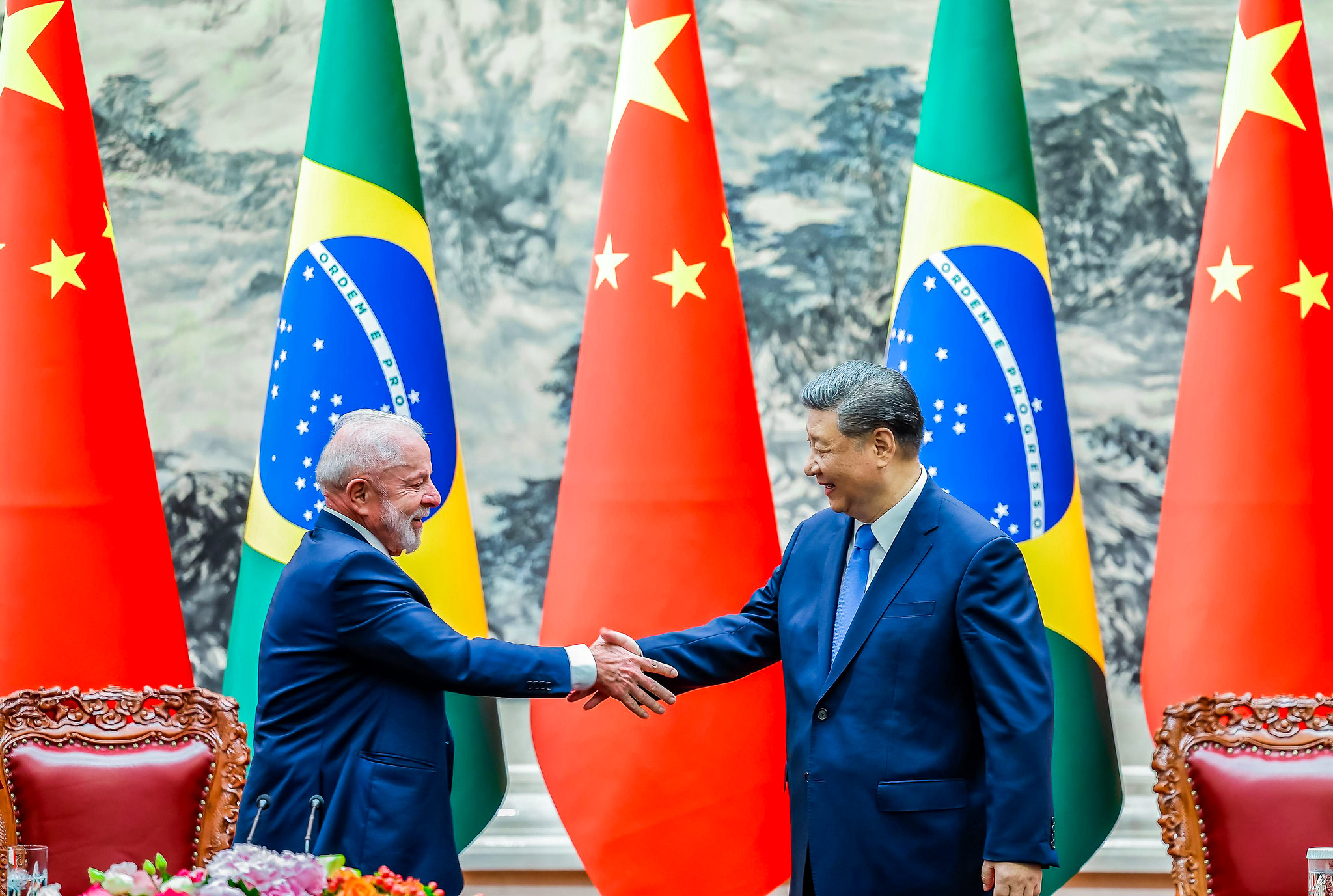
For Washington, Brazil is a key battleground in its contest with Beijing for global influence. China has been Brazil’s top trading partner since 2009, and in 2025 Brazil was the largest single destination for Chinese outbound investment, at US$6.1 billion. BYD builds cars in a former Ford plant in Bahia, Chinese state firms have bought into Brazilian copper, nickel, niobium, and lithium mines, and the two governments are studying a bi-oceanic railway to Peru’s Chinese-run port of Chancay.
Beyond infrastructure, financial ties are substantial: a 190 billion yuan (US$28.5bn) swap line supports trade outside the dollar; Brasília is preparing its first yuan-denominated bond; and China’s UnionPay has connected its apps to Pix, the payment system at the heart of Washington’s trade case against Brazil. Brazil’s embassy in Beijing also now hosts an army general and a rear admiral, a level of seniority otherwise reserved for Washington. As Lula put it, “no one is going to prohibit Brazil from improving its relationship with China.”
Lula has also diverged with Washington on key geopolitical issues. Under his administration, Brazil has cast itself as a mediator that opposes outside military intervention. Although Lula broke with Nicolás Maduro after Venezuela’s contested 2024 election, he said January’s U.S. seizure of Maduro crossed an “unacceptable line,” and recognized Delcy Rodríguez as interim president. Brasília also keeps working ties with Tehran, calls Israel’s Gaza campaign a genocide, and joined South Africa’s ICJ case against Israel. On Ukraine, Brazil condemned the invasion but declined to join sanctions, given its reliance on Russian fertilizer and diesel.
All of this feeds Lula’s core project, namely, a multipolar order anchored in BRICS and built on diplomacy and commerce rather than force. The 11-member bloc now accounts for about 49.5% of the world’s population and 40% of global GDP. Its New Development Bank is led by former Brazilian President and Lula ally Dilma Rousseff, re-elected through 2030, who reported in October nearly 24 billion reais (US$4.4bn) in approved financing for Brazil since 2023. A Bolsonaro victory could have pulled Brazil away from the bloc; Lula’s win, analysts say, gives it political continuity.
A setback for the Donroe Doctrine?
For Washington, Lula’s victory represents a blow to the Trump administration’s Donroe Doctrine, a push to reassert U.S. “dominance in Latin America,” modeled after the two-centuries-old Monroe Doctrine, meant to keep out foreign powers and maintain U.S. control over key assets. Put into practice, this has translated into policies like capturing Maduro while keeping a compliant Chavista regime in place, strikes on alleged drug vessels that have killed over 150 people, and a fuel blockade on Cuba.
A key part of the Donroe Doctrine has also meant the targeting of China – it has become the region’s top trading partner and is buying into strategic assets. The U.S. wants to maintain their “backyard,” their near-abroad, under the direct control of Washington and its interests – whatever that might mean.
Amid this great power contest, public opinion gives Lula room to maneuver. Pew Research Center’s 2026 survey found that Brazilians view the United States and China about equally, with U.S. favorability near historic lows. Opinions split sharply by ideology: 58% on the right see the U.S. favorably, against 30% on the left. Some 76% say the U.S. interferes in other countries’ affairs, versus 50% for China. Regionally, the 2026 Latinobarómetro found that 77% of Latin Americans opposed the U.S.-Israeli war on Iran and that, for the first time, more viewed China’s influence positively than America’s.
That drift toward China and toward a post-Western, multipolar order is likely to shape Brazilian foreign policy for years to come. Lula’s fourth term will consolidate Brazil’s standing as a middle power with global reach and as one of the most influential voices for multipolarity, one that Washington will find harder to pressure and easier to push away.
Featured image description: Lula and Xi Jinping meet in Beijing.
Featured image credit: (Ricardo Stuckert / Presidency of Brazil)